Most fitness apps deliver the same advice regardless of who you are or how your body is responding to training. Fitiv Pulse takes a different approach: its AI engine continuously processes your physiological data — HRV, training load, sleep quality, resting heart rate, and workout history — to generate recommendations that reflect your actual current state, not a generic template.
What is AI Fitness Coaching?
AI fitness coaching refers to the use of machine learning models to analyze athlete data and generate individualized training guidance. Unlike rule-based systems that apply fixed logic ("if heart rate is high, reduce intensity"), a trained AI model identifies patterns across multiple data streams simultaneously and generates recommendations that account for the interaction between variables.
In practical terms, this means the AI considers how your sleep last night interacted with yesterday's training load, what your HRV trend looks like over the past two weeks, and how your recent workout intensity distribution compares to your historical patterns — and synthesizes all of that into a specific recommendation about today's training.
Fitiv's AI coaching is not a chatbot that generates motivational text. It produces structured outputs: recommended training intensity, suggested workout duration, whether today should be a hard day, an easy day, or a rest day, and why.
How AI Differs from Rule-Based Fitness Apps
Traditional fitness apps use decision trees. A simplified example: if resting HR is more than 5 bpm above baseline, flag recovery concern. These rules work in isolation but fail when signals conflict or interact in complex ways. An athlete might have elevated resting HR because of a hard workout (appropriate) or because of oncoming illness (needs rest) — the same input, opposite correct response, and the rule-based system cannot distinguish between them.
Machine learning models trained on large datasets of physiological and performance data can identify these contextual distinctions. They recognize that elevated resting HR combined with declining HRV trend combined with reduced sleep quality over five days is a qualitatively different situation than elevated resting HR following a single race effort with normal HRV and good sleep.
Data Inputs the AI Analyzes
Fitiv's AI coaching engine draws from the following inputs, updated continuously:
- HRV (RMSSD): Daily morning readings and 7/30-day trend
- Resting heart rate: Daily baseline and deviation from personal average
- Training load: Acute load (7-day), chronic load (42-day), and the ratio between them
- Sleep score: Duration, consistency, and estimated quality from Apple Watch sleep tracking
- Workout history: Intensity distribution across zones, workout type frequency, and time since last high-intensity session
- Subjective feel (optional): RPE-based input after workouts to calibrate model to individual perception
AI-Generated Training Insights
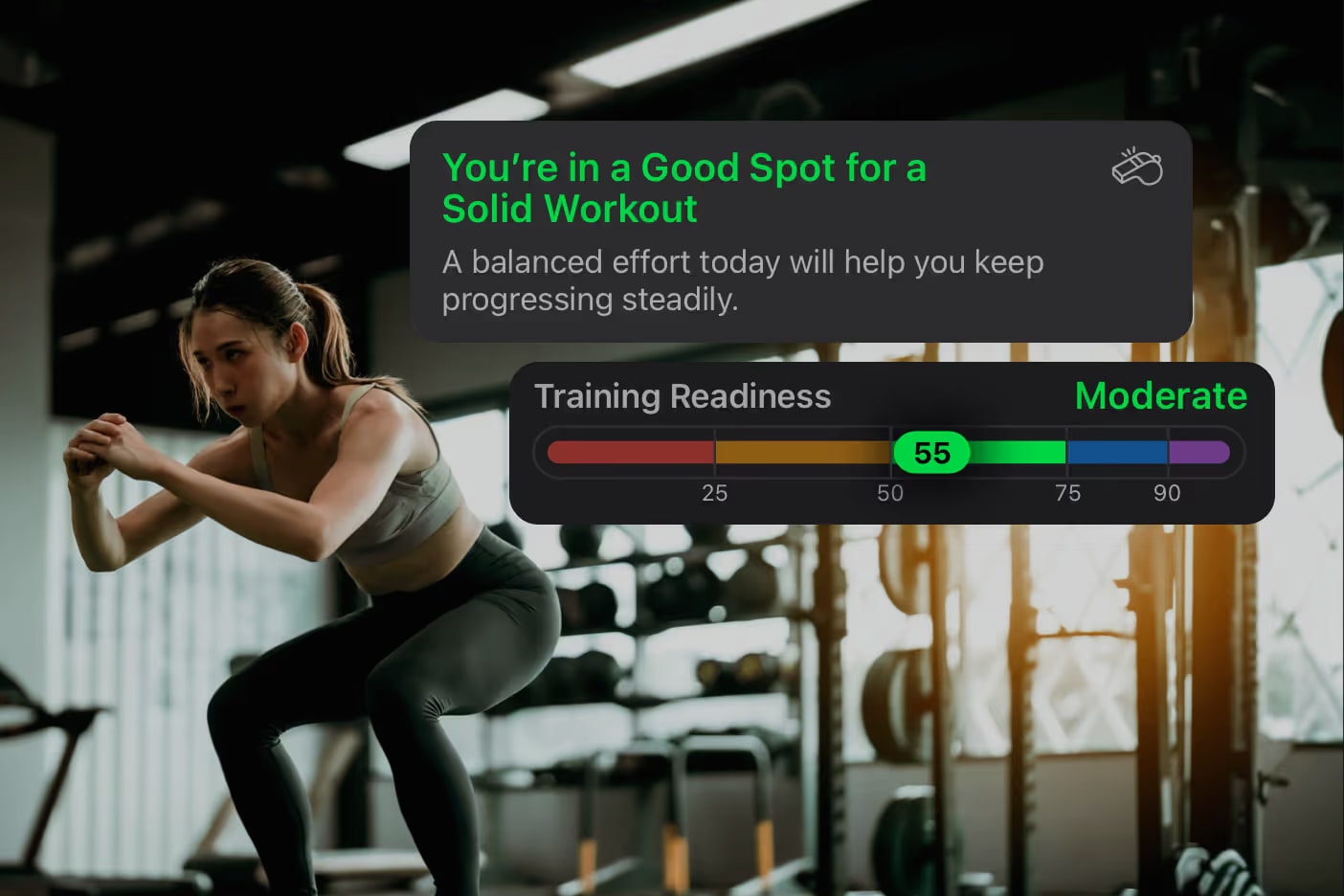
Each morning, Fitiv produces a readiness score alongside a brief AI-generated insight explaining the primary drivers of that score. These insights are specific: "HRV is 12% below your 7-day average following yesterday's threshold run. Resting HR is 4 bpm elevated. Recovery score is 58 — light aerobic work or rest recommended today."
This is categorically different from generic push notifications. The insight reflects your specific data on that specific day, and the recommendation changes dynamically as inputs change.
How Fitiv's AI Coaching Works
The coaching engine operates in three layers:
Layer 1 — Signal processing: Raw sensor data from Apple Watch, Bluetooth HR monitors, GPS, and power meters is cleaned, normalized, and converted into standardized metrics. This layer handles sensor-specific calibration differences between, for example, a Polar H10 chest strap and Apple Watch optical PPG.
Layer 2 — State estimation: The processed signals are combined into physiological state estimates: current recovery status, accumulated training stress, aerobic fitness level, and trajectory (improving, stable, or declining). This layer is where the multi-variable pattern recognition occurs.
Layer 3 — Recommendation generation: The state estimates are mapped to training recommendations. The output is not a single number but a structured recommendation with a primary action (train hard / train easy / rest), supporting context, and optional specific workout suggestions based on your training history and goals.
Personalization Over Time
The AI model improves its recommendations as it accumulates more data from your training. Early recommendations (first 2-4 weeks) rely more heavily on population-level patterns. After 6-8 weeks of consistent data, the model has sufficient individual data to weight your personal response patterns more heavily.
Concretely: if your HRV typically recovers faster than average after long runs but slower after strength sessions, the model will calibrate to that pattern and produce more accurate post-workout recommendations.
AI Coaching Without Wearable Data
For athletes who do not wear a monitor during sleep, Fitiv's AI operates on the available data. Without sleep score inputs, the model falls back to HRV and training load as primary signals. Without any morning HRV measurement, the model uses training load trend and workout history. The recommendations become less precise but remain contextually relevant.
Why AI Coaching Matters for Athletes
The core problem that AI coaching solves is the mismatch between planned training and actual readiness. Elite athletes work with coaches who make daily adjustments based on how an athlete looks, feels, and performs. The vast majority of athletes train alone and follow fixed plans that ignore real-time physiological state.
This matters most at the extremes. Following a hard training day when your body needed recovery is a common driver of overuse injury and non-functional overreaching. Taking an easy day when your body was primed for adaptation is a missed opportunity. An AI system that reliably identifies these conditions — even imperfectly — has measurable value for training outcomes.
Fitiv's approach is conservative in one important respect: it does not generate workout plans from scratch or prescribe specific exercises without user input. It advises on intensity and volume, leaving exercise selection to the athlete. This reflects the current state of what personalized AI coaching can reliably do: physiological state estimation is well-supported by sports science; automated exercise prescription is not.
Frequently Asked Questions
Q: Does Fitiv's AI coaching require a subscription? A: AI insights and daily readiness recommendations are part of Fitiv Pulse's core feature set. Check current pricing at fitiv.com for the latest subscription details.
Q: How is Fitiv's AI coaching different from WHOOP's strain and recovery system? A: WHOOP's system is proprietary and requires WHOOP hardware. Fitiv works with Apple Watch, Garmin, Polar H10, Wahoo TICKR, Scosche Rhythm+, and other Bluetooth HR monitors. The analytical approach is similar in concept — both combine HRV, sleep, and training load — but Fitiv integrates strength training data (sets, reps, weight) into the training load calculation, which WHOOP does not do natively.
Q: Can the AI recommend specific workouts? A: Fitiv's AI recommends training intensity and duration targets for the day. It can suggest workout types from your history (for example, "a Zone 2 run of 45-60 minutes fits today's readiness profile") but does not generate arbitrary exercise prescriptions. Strength training workouts can be built in the workout builder and the AI adjusts load recommendations based on your strength session history.
Q: What happens if I disagree with the AI recommendation? A: You can always train as you choose. Logging your actual workout — regardless of what the AI recommended — feeds back into the model and improves future calibration. If you consistently train hard on low-readiness days without negative outcomes, the model adjusts its sensitivity for your profile over time.