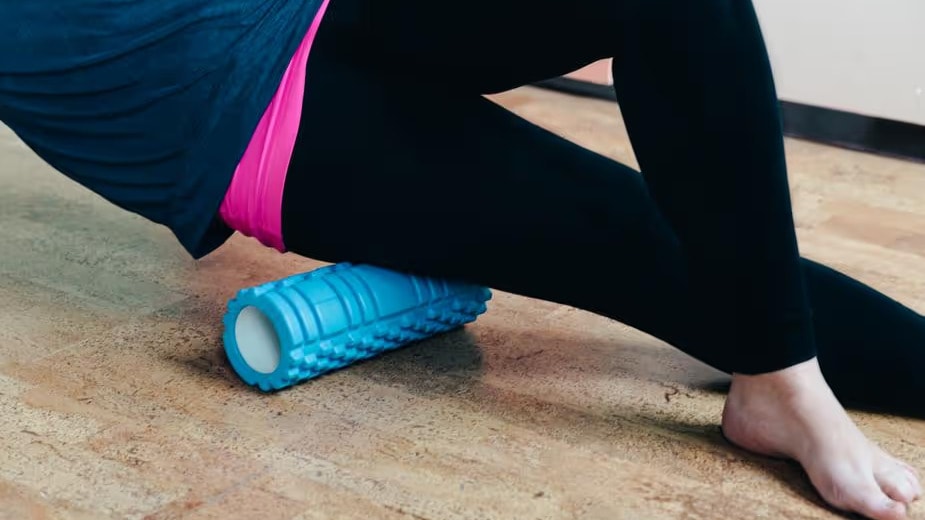
Foam rolling is a type of self-massage: you lean a muscle on a firm foam cylinder and roll back and forth slowly. It's worth trying if you want looser muscles before a workout or less soreness after one. The research shows small, short-lived gains in flexibility and a modest drop in soreness, without hurting performance (Wiewelhove et al., 2019). Expect it to make you feel better, not to change your fitness.
If you've been to a gym lately, you've probably seen someone hunched over a foam roller and wincing. Here's what it actually does, how to do it, and where it fits in a sensible recovery routine.
What Is Foam Rolling?
Foam rolling is the best-known form of self-myofascial release: using a tool such as a foam roller, massage ball, or roller stick to put pressure on your own muscles and the connective tissue around them (fascia). It's like a sports massage you give yourself, with your body weight supplying the pressure.
The classic explanation is that rolling breaks up "knots" or releases tight fascia. That story doesn't hold up well (Behm and Wilke, 2019). Fascia is tough tissue, and the pressure you can put on it with your body weight is unlikely to physically reshape it. Most researchers now think the benefits come from your nervous system. Pressure and movement change how tight the muscle feels and how much stretch you can tolerate, at least for a while.
That matters for how you use it.
You aren't fixing tissue that's broken, so you don't need to grind through pain.
Foam Rolling Benefits: What the Research Shows
Foam rolling has been studied a lot over the past decade, and the findings are fairly consistent:
- Short-term flexibility. Rolling a muscle before training increases range of motion for a short time, often within one session (Wilke et al., 2020). A 2019 meta-analysis by Wiewelhove and colleagues found that rolling before exercise slightly improved flexibility and sprint performance, and that rolling afterward reduced muscle pain (Wiewelhove et al., 2019).
- No performance cost. Unlike long static stretches right before lifting or sprinting, rolling doesn't appear to reduce strength or power afterward, so it works well as part of a warm-up (Wiewelhove et al., 2019; Konrad et al., 2021).
- Less soreness after training. Rolling after a hard session modestly reduces how sore and tender muscles feel over the next day or two (Zhou et al., 2024).
- Modest, short-lived effects. One session's gains are real but fade quickly. Rolling regularly for more than a month can build flexibility about as well as a stretching routine (Konrad et al., 2024), but evidence for faster muscle repair or fewer injuries is still weak.
The honest summary: foam rolling is a cheap, low-risk way to feel looser and less sore. It isn't a recovery shortcut.
How to Foam Roll
You need very little: a foam roller (or a firm ball for smaller areas) and some floor space.
- Pick a large muscle. Common targets are the calves, hamstrings, quads, glutes, outer hips, and upper back.
- Set the roller under it and lower your body weight onto it. Use your hands and other leg to control how much pressure you put on it.
- Roll slowly, roughly an inch per second, along the length of the muscle.
- Pause on tender spots for a few breaths. You can also gently bend and straighten the nearby joint while you hold.
- Keep breathing and stay relaxed. If you're tensing up or holding your breath, ease off the pressure.
| When | Goal | How long |
|---|---|---|
| Before training | Loosen up as part of a warm-up | 30–60 seconds per muscle, then your normal warm-up |
| After training or on rest days | Ease soreness and tightness | 1–2 minutes per muscle, at a slower pace |
Before a workout, follow rolling with a few minutes of movement that matches the session ahead, such as easy cardio, bodyweight squats, or light sets. Rolling works best as one part of a warm-up, not a replacement for it.
Does Foam Rolling Hurt?
It can feel uncomfortable, especially on tender spots, but it shouldn't really hurt. You don't have to push through pain to get the benefit. Aim for pressure that feels intense but tolerable, roughly a 5–7 on a 10-point scale, where you can still breathe normally and keep the muscle relaxed.
A few rules keep it safe:
- Roll muscle, not bone or joints. Skip the knees, elbows, and other bony areas.
- Don't roll your lower back directly on a roller. Your upper back is fine.
- Stop if you feel sharp, shooting, or numbing pain. That's a sign to stop, not something to push through.
- Check with a doctor or physical therapist first if you have an injury, a blood clotting condition, osteoporosis, or varicose veins, or are pregnant.
Should You Start Foam Rolling?
If it makes you feel looser, less sore, or more ready to train, it's a worthwhile five minutes. It's inexpensive, easy to learn, and low risk. If it doesn't do anything for you, you're not missing a key part of recovery.
Just keep it in proportion. Sleep, enough protein, and sensible training load affect your recovery far more than any roller. Our recovery guide covers those basics.
How FITIV Fits Foam Rolling Into Your Recovery
FITIV doesn't measure foam rolling, but it helps you build the habit and decide when to use it:
- Log your sessions. In FITIV Pulse, you can track a rolling or mobility session as a workout and set its activity type to Flexibility or Preparation and Recovery, so it shows up in your history next to your training.
- Make it a habit. Add the Stretch Routine habit to remind yourself to do your mobility work regularly.
- Know which days to focus on recovery. Your Recovery score reflects your HRV, resting heart rate, and sleep, and Training Readiness also accounts for your recent strain and training load. When readiness is low, an easy day with walking and some rolling is often a better choice than another hard session.
Frequently Asked Questions
Is it better to foam roll before or after a workout?
Both work, for different reasons. Rolling before a workout briefly improves flexibility without reducing strength, so it fits into a warm-up. Rolling afterward or on rest days helps ease soreness. Choose the timing that fits your goal, or do a short session at both times.
How often should you foam roll?
Daily is fine if it feels good, since foam rolling is low-stress for most people. Because the flexibility gains are short-lived, often gone within minutes to half an hour, rolling right before you train or when you're sore gets you the most out of it. A few minutes per session is enough.
Is foam rolling better than stretching?
Neither is clearly better. Both increase range of motion for a short time, and combining them doesn't appear to add much over either one alone. Foam rolling is less likely to reduce strength right before training, and over several weeks, regular stretching and regular rolling build flexibility about equally well, though stretching has been studied far more.