How to Use the Calculator
- Pick how you know your FTP. Enter it directly, or use a test: the calculator converts 20-minute power (× 0.95) or ramp test 1-minute power (× 0.75) into FTP.
- Add your weight, if you like, in kilograms or pounds, to see your FTP in watts per kilogram (W/kg). That's the number that matters most for climbing.
- Read your zones. Each zone shows its watt range and the share of FTP it covers.
The 7 Power Zones
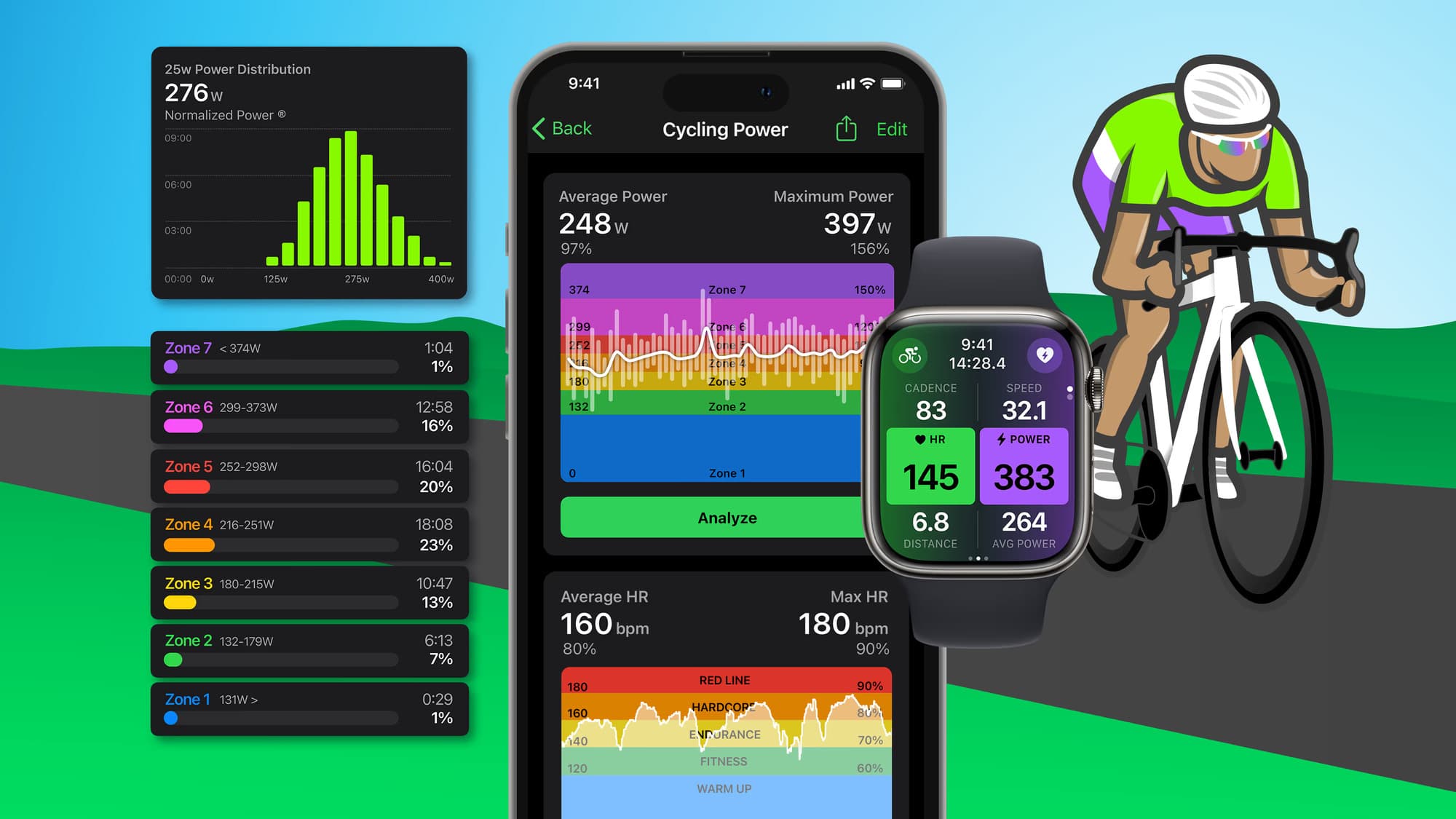
FITIV Pulse uses the percentages from Andrew Coggan's seven power zones. Each zone starts at its percentage of FTP, rounded up to the next watt. In the app the zones are labeled Zone 1 to Zone 7; the names below are Coggan's.
| Zone | % of FTP | What it trains |
|---|---|---|
| Z1 Active Recovery | Under 55% | Recovery rides, warm-ups |
| Z2 Endurance | 55–74% | Aerobic base; long, steady rides |
| Z3 Tempo | 75–89% | Sustained, comfortably hard efforts |
| Z4 Lactate Threshold | 90–104% | Raising FTP; 10–20 minute intervals |
| Z5 VO2 Max | 105–119% | 3–8 minute hard intervals |
| Z6 Anaerobic | 120–149% | 30-second to 2-minute efforts |
| Z7 Neuromuscular | 150% and up | Sprints and max power |
Example: FTP of 280 watts
| Zone | Watts |
|---|---|
| Z1 | 0–153 W |
| Z2 | 154–209 W |
| Z3 | 210–251 W |
| Z4 | 252–293 W |
| Z5 | 294–335 W |
| Z6 | 336–419 W |
| Z7 | 420+ W |
How to Test Your FTP
- 20-minute test: after a thorough warm-up and a hard 5-minute opener, ride as hard as you can sustain for 20 minutes. FTP is 95% of your average power. It's the most widely used test, but pacing takes practice.
- Ramp test: power rises by a set amount each minute until you can't hold it. FTP is 75% of your best 1-minute power. It's shorter and easier to pace, but can overestimate FTP for riders with a strong sprint.
Our FTP test guide has the full protocols, and cycling power zones explains how to train with them. Don't have a power meter? Heart rate zones work well too: try the heart rate zone calculator.
Watts per Kilogram
Raw watts favor bigger riders on the flat, but on climbs what counts is power relative to weight. Dividing FTP by body weight in kilograms gives W/kg. Two riders with a 250-watt FTP climb very differently at 60 kg (4.2 W/kg) and 85 kg (2.9 W/kg). Track your own W/kg over time: it rises when you get stronger, lighter, or both.
Frequently Asked Questions
How do I calculate FTP from a 20-minute test?
Multiply your average power for the 20-minute effort by 0.95. For example, 295 watts for 20 minutes gives an FTP of about 280 watts. The 5% reduction accounts for the fact that most riders can hold a little more power for 20 minutes than for a full hour.
How do I calculate FTP from a ramp test?
Multiply your best 1-minute power, usually the last full step you completed, by 0.75. A rider whose last full minute averaged 370 watts has an FTP of about 278 watts. Riders with a big sprint can get an inflated result from a ramp test.
What are the 7 cycling power zones?
Based on Coggan's model: Active Recovery (under 55% of FTP), Endurance (55–74%), Tempo (75–89%), Lactate Threshold (90–104%), VO2 Max (105–119%), Anaerobic (120–149%), and Neuromuscular (150% and up). FITIV Pulse uses these same percentages and labels the zones Zone 1 to Zone 7.
What is a good FTP in watts per kg?
It depends on age, sex, and training history. Many recreational cyclists sit somewhere around 2–3 W/kg, regular club riders often reach 3–4 W/kg, and elite racers can hold well over 5 W/kg. Compare yourself with your own past numbers rather than with others.
How often should I retest my FTP?
Every 6–8 weeks during a focused training block, or whenever your training changes a lot, such as after illness or a training camp. If threshold intervals start to feel easy, it's probably time to retest.